Monday, February 10, 2014

MELBOURNE AND MORE

It's hard to believe that there are only 23 million people living on an island continent almost as expansive as the USA, and even more surprising that there are more kangaroos here than people!  I arrived in a Melbourne heat wave.  It was 100 degrees over the weekend and I almost fainted on a city walking tour on Sunday.  I dropped out of the tour, but got some city photos before I was overcome with the heat.  

The tour started in front of the library, and the guide suggested a look at one of the reading rooms before the tour began.  I could read in this beautiful room any day of the week.


There was a lovely exhibition of art outside this room, mostly paintings of Melbourne and the surrounding area in earlier days.  The library itself was a beautiful building.


You could play a game of chess near the front entrance.


This very tall young man is Hugo, our tour guide (and a very good one) and the woman is Jeannie from Orange, California, who was my walking buddy.


One of the buildings we saw was the Royal Exhibition Building, which was built in the 1880's for the Melbourne International Exhibition, and then hosted Australia's first Parliament in 1901.


I loved the fountain in the front with the duck-billed platypuses peeking over the second tier,


This is the jail where the infamous Ned Kelly was imprisoned before he was hanged at this site at age 25.  This bold bank robber was thought by some to be Australia's Robin Hood.  Health Ledger starred in a film about this notorious fellow.


Graffiti art is apparently encouraged by some in Melbourne, and you can find some interesting art down little alleys in the downtown area.


I don't remember what this building was, but I just liked it.


This is one of the older theaters that is still in use, with Melbourne's more modern skyscrapers as background.


After I quit the tour, I cooled off in a shopping mall and then decided it was a good day for a museum visit.  I headed for the Melbourne Museum which I knew was behind the Royal Exhibition Building.  Their special exhibit would have delighted 007 fans.


Not being a Bond fan, I recognized only 3 ofthe 6 actors who have portrayed him.  I spent a couple of hours enjoying the excellent section on the First Peoples, the aborigines of Australia.  Theirs is as sad a story as that of the American Indian.  

I was very surprised when I left the museum that the temperature had dropped significantly.  All it took was a shift in the wind from a northern to southern breeze to cool the temperature by 20 degrees, exactly the opposite of home.  And there was no storm to announce this dramatic shift!

I left the city yesterday to take a tour of the Great Ocean Road, a 150 mile two-lane road that winds its way along the southeastern coast of Australia.  It's actually a war memorial, built by the returning solders of WWI who could not find work in Australia's then very depressed economy.  I had thought about renting a car and doing the drive myself, but I was glad to just sit back and enjoy the ocean views.


The Twelve Apostles are Australia's number 1 tourist attraction.  There were originally 15 of these limestone stacks off the shores of Port Campbell National Park, but six have fallen.  Originally called "Sow and Piglets", they were renamed the Twelve Apostles after 3 of them fell.  Three more have fallen since, so I think they should come up with a new name for them.  


Another famous rock formation along this shoreline is London Bridge.  This is what it orginially looked like.  You could walk from the shore out to the edge of the rock formation.


The arch closest to shore collapsed unexpectedly in1990, and this is what it looks like now.

 
Fortunately, no one was killed when it collapsed, but there were two people who had just crossed over to the second arch when it happened and became stranded on the now island.  Fortunately, someone saw the collapse, and a helicopter was sent from Melbourne to rescue them.  Everyone wondered why the two covered their faces to prevent the cameras from seeing their identity.  As it happens, it was a well-known Melbourne businessman and his mistress who were "caught in the act", so to speak.

Often, people on these tours see kangaroos and koalas on their all-day journey.  I did see one kangaroo, but no koalas.  Since they are both noctural animals, it's not a real surprise, but you'd think, since kangaroos outnumber people here, that we might have sighted more than one.

Thursday, February 6, 2014

A SLICE OF PARADISE

Is there such a thing as overdosing on scenic wonders?  When it becomes a daily event, you begin to look for something that tops what you've already seen.  The East Coast of the South Island is very different from the West Coast and its rugged mountainous Alps.  Its mountains are gentle mounds and there was a stretch of road between Dunedin and Christchurch that was actually flat.  And along the road, where there was much more traffic than there was on the western side, there were several towns of greater size than I saw on the opposite side.  I was actually getting a little bored.  And then I turned east to the Banks Peninsula, where I was in search of Akaroa, a historic French and British settlement nestled in the heart of an ancient volcano.

These sheep provided a break from the monotony of the flats.  The farmer and his three dogs were moving them along the road from one pasture to another.  He was going to try to clear space on the road so I could pass, but I wasn't in a hurry, and it was fun to watch the dogs keeping them in formation.  I took a video, but I can't see how to post it.


The flats turned quickly into curvy roads that went up and down and all around the mountains you must cross to get to Akaroa.  In Maori, Akaroa means "long harbor", and this is the spectacular view you have when you reach the crest of the final mound and start heading downward to this town of 700 that swells significantly in the summer.


Yes, that's a cruise ship in the distance, and there were two that came in to "swell" the population.  I stayed at a lovely B&B that was the home of a gregarious older woman named Rosemary.  She has a beautiful garden in front of and all around her house.


This was the view from my bedroom.  It was late afternoon and not a very beautiful day when I arrived, but the next morning the sun cooperated to light up the scene.


The town itself is small, but there's everything you need--small supermarket, pharmacy, bank, and lots of restaurants.  I walked into town for dinner and took some photos along the way.  I don't know what kind of tree this is, but I don't think we have it in the U.S.


And there were more beautiful flowers along the way to town.  I don't know what these are either.


There are lots of gulls in the harbor, of course, and they can be quite aggressive, swooping down quite close to your head, but these guys were just chilling out.


The pier with its bright blue-roofed buildings brightened the gray day.


Rosemary told me about a celebration that was taking place the following day in a nearby bay, the commemoration of the signing of a treaty between the British and the Maori in 1840.  It is a national holiday.  She explained that Maoris would be arriving in their long boats to be greeted by British Naval Officers.  I decided this would be a great way to spend the morning before I drove to the Christchurch Airport to catch my plane to Melbourne.  The drive to the bay was along a very narrow road that went up and down and all around the hills, but provided some nice scenery.


Unfortunately, Rosemary wanted cash for my room payment and I had to find an ATM before I left, which made me late for the ceremonial arrival of chanting Maori.  All I got were photographs of their long boats.


The Maori do beautiful wood carving on everything, including the bow and stern of their boats.


There was a large crowd there of tourists and locals and after about 45 minutes, there was some kind of ceremony where a Maori spoke in Maori to the Naval Officers present for this part of the commemoration.


Again, I wished for more time to explore this amazing peninsula, but had to rush off to Christchurch.  I'm so happy I came to New Zealand, and now I understand why other travelers' faces lit up and smiled when remembering their time here.  It's an amazingly beautiful country with equally lovely people, and I could spend a lot of time here.  I also understand why Ruth Golden Gelman, the nomad who inspired my journey, lived here for a few years.  I reluctantly leave for my next adventure in Australia.

Monday, February 3, 2014

SOUTH BY SOUTHEAST

After the boat cruise on Doubtful Sound, I spent the afternoon driving through the countryside to an area called "The Catlins", where I would be spending just one night.  The Catlins features a scenic coastline and a dense rainforest, which harbors many endangered species of birds, as well as marine life and thousands of sheep, but not that many people.  There are only about 1,200 people living in a 720 square mile area.

The terrain I traveled to the Catlins was quite different from the West Coast with its rugged mountains.  It was all rolling brown hills dotted with sheep.  I didn't stop for photos because I wanted to get to the place I was staying as soon as possible.  And here's why.

 
This was the view from my bedroom!


This entire house was devoted to travelers.....with three bedrooms and shared living room, kitchen and dining room.  Only two of the bedrooms were occupied that night.  My housemate was a very mature and intelligent 21-year-old Australian named Oliver.  I took a long walk on the beach after arriving, hoping to see the rare yellow-eyed penguin, sea lions, or seals, but there was nothing.  I talked with a couple of natives who were sheep farmers about how it is to live in such a sparsely populated area, as well as a bit about sheep farming.  

I met Oliver later and he said he had seen a sea lion on his beach walk....luckier than me.  The next morning, Oliver claimed to see some seals playing in the waves, so I ran down to the beach, but his eyes must have been playing tricks on him, because there were no seals.  Unfortunately, I had to leave, and, at Oliver's suggestion, I made a detour to Nugget Point where he said I could be sure to see some seals and maybe penguins.  The drive went along the coastline for a while.  These cows certainly have a gorgeous view.


Then the road turned inland through beautiful rolling green hills.


And many of the hills were dotted with sheep as far as the eye could see.  


There were seals at Nugget Point, but you needed binoculars to see them. They are just tiny black dots in this photo. 


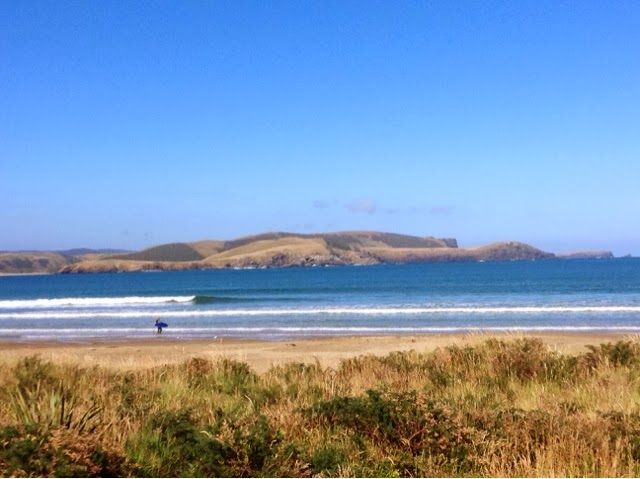
I drove the scenic route from Nugget Point to Dunedin, the second largest city on the South Island.  The road was almost on the beach for much of the way, and I stopped a couple of times to enjoy deserted beaches.


And beautiful driftwood.


Dunedin seemed like a huge metropolis compared to the dots of towns I'd passed through in a blink on the way.  I think if there are 10 houses close together here, you have a town.  I had to pay close attention to my driving--there are even stoplights here.  Thanks to my GPS, I found the place I'm staying with no trouble.  It's up in the hills overlooking Central Dunedin.  I'm in a little studio apartment that has to share bathroom facilities with another room, but no one else is booked, so I've got the place to myself.  I went downtown last night and poked around for an hour, then decided to go to a movie...The Railway Man.  Pretty good.

Today, I toured Lanarch Castle and its grounds, which is on the Otaga Peninsula. 


It was a pretty gray day when I arrived, so there are no spectacular photos of the mountaintop view on my camera.  The entrance to the castle was guarded by some eroded, but fierce statuary.


This is a fairly modest castle, with a tragic history that includes the early death of the owner's first two wives, the suicides of the owner and his only son, and a lengthy legal battle between the owner's third wife and his children by the first two.  It's also said to be haunted by the owner's first wife.

The grounds had beautiful flower gardens, and I share these summer beauties with my Michigan friends who may wonder if they'll ever see summer colors again.


And here's one lovely Monarch.


I toured the inside of the castle also, but there was nothing as stunning there.

I continued on from the castle to take a boat cruise where, again, I hoped to see some wildlife.  We did see several young albatross soaring in from the sea.  And we saw seals, but they were too far away to photograph.  The crew claimed there was a blue penguin surfaced on the water near the boat, although I couldn't see it.  But the albatross were fun to watch.  
 

I had hoped to see more of Dunedin...there are some beautiful buildings I've driven by that I'd like to find again and photograph, but I have a 5-hour drive tomorrow to Akaroa, southeast of Christchurch, so I need to leave in the morning.  I've wanted to linger everywhere on this beautiful island.  It's a little piece of paradise.

DOUBTFUL SOUND

I've been following the route laid out for me by my friends in Auckland, and so far, it's been a lovely tour.  Leaving Queenstown, I headed south for Te Anau to spend the night before boarding the cruise boat for an overnight trip on Doubtful Sound.  There's a nice lake in Te Anau, and the place I stayed there was really nice, too.


Doubtful Sound is a large and imposing fiord in Fiordland, located in the far southwest of South Island, New Zealand.  It got its name from the famous navigator, Captain Cook, who called it Doubtful Harbor because he questioned whether it was navigable.  While its name was later changed to Doubtful Sound by whalers and sealers, it's actually a fiord, not a sound because it was formed by glaciers.

We set off at midday, taking a boat across Lake Manapouri, then boarded buses to cross the mountain pass to the Sound.  The bus stopped briefly to give us our first peek at our destination.


This was our cruise boat, photo snitched from the website.


I wasn't able to book a twin room, so I was in the "cheap seats" where four people bunk together in a small cabin, and there was no guarantee that my bunkmates would be female.  Fortunately, I had two lovely French women in my cabin--Caroline and Nathalie--both notary publics from Paris.  A notary public in France is a full-fledged lawyer, specializing in writing contracts of all types--real estate sales, wills, prenuptials, etc.  These ladies were really charming, and we spent some time together along with a couple from the Netherlands, Dini and Simon.


It was a relaxing cruise, and you got quite an education about the Sound from the crew.  The mountains in the Sound are solid rock and yet they support a verdant rainforest.


It rains most of the time, but there was, as the crew stated, a two-day drought.  You can see a small waterfall here, but when it's raining, this is what you might see.  The lines on the rock face are caused by tree avalanches.  When trees become too heavy to stay rooted in the thin soil, they fall, creating a chain reaction downward.  When it rains, these tree lines become narrow waterfalls.


We cruised around the Sound all afternoon and into the evening, stopping once for kayaking and swimming.  I forgot about the kayaking opportunity and hadn't packed a swimsuit or a second pair of pants to wear, so I remained an observer.


We cruised to the Tasman Sea outlet, where we saw dozens of seals lounging on the rocks.  Unfortunately, the sun was not behind us, so this picture is very dark.  I will replace it later when Dini sends me her superior pictures.


The Sound begins to change from dark greens to shadows as the sun goes down.


The sunset was lovely, and afterward we enjoyed a decent buffet dinner.  


My bunkmates decided to watch the sunrise, so when they got up, I decided to join them, since I was awake anyway.


The second day was much like the first.  After a buffet breakfast, we cruised some more.  The "drought" continued, and we had another beautiful sunny day.


The crew continued to educate us on all the flora and fauna on the islands.  (I hope there won't be a test!)


It was a very relaxing way to spend a couple of days enjoying the wonders of nature.


At midday, we journeyed across the pass again and bid our wonderful crew farewell.